From Critic's Corner in what appears to be next week's New Yorker (May 4, 2009):
The YouTube Symphony, a global orchestra assembled from online audition videos, may sound like yet another groan-inducing attempt to make classical music hip. But there’s some method in the marketing madness: YouTube has become a serious resource for professional musicians, who use it to investigate up-and-coming talent.
Read the rest of the article here. There's a great illustration of MTT, as well.
You can watch all sorts of videos, from auditions to snippets of the musicians' arrival in NYC to an hour long "Act One" of the actual Carnegie Hall concert, as introduced by Michael Tilson Thomas at the YouTube Symphony Orchestra Channel. MTT called the three-day event "a classical music summit/conference/scout/jamboree with an element of speed dating thrown in." ☺
The composer of the featured musical work in the concert (Internet Symphony No. 1 "Eroica"), Tan Dun, is also the composer of the music in one of my most-loved films, Crouching Tiger, Hidden Dragon.
The YouTube Symphony Orchestra's show features soloists, chamber groups, chamber orchestra, large orchestra, electronica and multi-media, and samples diverse periods and styles of classical music, including works by Gabrieli, Bach, Mozart, Brahms, Villa-Lobos, John Cage and Tan Dun’s Internet Symphony No. 1 “Eroica.”
Michael Tilson Thomas conducts the first collaborative online orchestra, and can be heard talking about the project here at NPR's All Things Considered. From that article:
From fiddlers to French-horn players to percussionists, musicians in more than 40 countries submitted their auditions via YouTube. They were required to post two videos: one specifically highlighting their instrumental talent and another performing a piece by composer Tan Dun, written specifically for the project.
Ninety musicians from more than three thousand that auditioned were chosen and flown to NYC for a three-day workshop, culminating in tonight's performance.
Thanks to LB for the breaking news alert! I had heard about the project last December, but hadn't thought about it again since then. LB has a great YouTube video of the orchestra posted at her blog. Keep your eyes peeled for the trumpet-playing Clone Trooper!
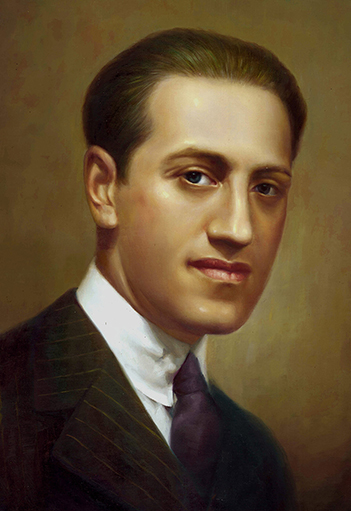
George Gershwin is way up there on my mental list of favorite American composers. From Rhapsody in Blue to the many wonderful songs ("Summertime," "Someone to Watch over Me," "Embraceable You," and "I Got Rhythm," just to name a very small portion of the man's output), his music bridges the gap between the Broadway stage and the classical concert hall.
Gershwin was the son of poor Russian emigrants who arrived in the U.S. a few years before he was born in 1898. At age twelve, he began to play the piano, and by age fifteen, had dropped out of school to hold down a job as a song-plugger in Tin Pan Alley. It was here that he became well-known among singers and other song-writers. His first song ("Swanee") was published less than two years later, and singer Al Jolson's recording of the song in 1920 received great acclaim.
With his brother Ira, George wrote many successful songs and musical comedies throughout his life. The now-famous songwriter sought out well-known composers for instruction in harmony and composition, and took sporadic lessons with musicians such as Rubin Goldmark and Henry Cowell. Besides the well-known Rhapsody in Blue (1924) and opera, Porgy and Bess (1935), Gershwin's classical works include a piano concerto (1925), a set of variations for piano and orchestra based on his song, "I Got Rhythm" (1934) and Cuban Overture (1932), along with several other pieces. Anna Harwell Celenza has a perfectly lovely book featuring the story of how the composer came to write his first major classical orchestral composition: Gershwin's Rhapsody in Blue. In it she mentions some of the influences on Gershwin's compositions, including ragtime and Klezmer. The book includes a CD of the piece, as well, as played by the composer himself on a piano roll.
I have two favorites of Gershwin's that are among his lesser known classical pieces: Lullaby for Strings, and Prelude No. 2 from a set of three Preludes for Piano (1926). There is a YouTube video of a string quartet playing the Lullaby in its entirety here. The video quality isn't great, but the audio quality is pretty good, and the quartet is decent, even if they play the piece too fast for my taste (faster than I played it back in my wedding gig-playing days, anyway). Here it is (in Amazon exerpt form) at the "right" speed, which makes it just, well, dreamy:
Tomorrow we choose a new President here in the U.S. It's an important day for this country. I can think of no other composer who more fabulously represents American classical music than Aaron Copland. Most people are familiar with the opening brass and percussion extravaganza in Fanfare for the Common Man, but there is much more to explore in Copland's diverse litany of work. Michael Tilson Thomas presents the Fanfare and several others in Keeping Score: Copland and the American Sound, part of a series both on DVD and re-running on PBS that I highly, highly recommend for anyone even vaguely interested in orchestral music. The DVDs are in our library system here in New England, but I'm hoping St. Nick drops them down the chimney for me in a few weeks.
One of my favorite Copland compositions is Appalachian Spring, another piece of music that is featured on Keeping Score. Copland uses Simple Gifts, a Shaker tune, in the middle of the piece, and this particular section is just plain inspirational. Enjoy, and go vote!