Good Monday morning to you!
Completed two years earlier in 1812, Beethoven's Eighth Symphony was performed for the first time on this day in 1814.
Here is Leonard Bernstein conducting the Vienna Philharmonic.
Showing posts with label Music Monday. Show all posts
Showing posts with label Music Monday. Show all posts
Monday, February 27, 2012

Friday, December 23, 2011
Favorite Holiday Music No. 17 - 12 Days (the David Chase remix)
I laughed until my eyes were tearing almost constantly the first time I heard David Chase's arrangement of "The Twelve Days of Christmas" as performed by the Boston Pops and the Tanglewood Festival Chorus under the direction of the fabulously brilliant Keith Lockhart. The maestro has this to say about the piece:
added on the afternoon of 12/23:
You might just be able to catch a live performance of "The Twelve Days of Christmas" via Classical New England online live streaming on Christmas Eve at 7 p.m., EST. Check out this link to see what else Classical New England has to offer this holiday season.
And I didn't mention it earlier, but this arrangement of the familiar carol has snippets of music from Handel, Mozart, Beethoven, Offenbach, Souza, Saint-Saens & Tchaikovsky to Rogers & Hammerstein and even an unexpected appearance by a popular seventies British rock band whose name I will not mention for fear of spoiling the surprise. It is truly an inventive re-imagining of the original song, and David Chase gets my highest respect for coming up with it!
As an aside, the one new Christmas picture book I bought this year (I can't believe it was only one!) was Laurel Long's Twelve Days of Christmas, which is absolutely gorgeous.
Happy Holidays!


"I knew we had a winning new arrangement of 'The Twelve Days of Christmas' when we premiered it in 2007, but the audience's enthusiastic response night after night was unlike anything I've ever seen at the Pops," said Boston Pops Conductor Keith Lockhart. "Then a flood of letters and phone calls came in requesting a recording of the new arrangement-an incredibly creative twist on one of the greatest Christmas-time classics. We knew then and there that we would make a recording of 'The Twelve Days of Christmas' and that it would become a staple of our Holiday season programming."The piece is available for sale in various audio download formats at the BSO website. There's a commercial for it on the BSO's YouTube channel and as a free podcast on iTunes that lets you hear little snippets, but the music is mostly covered up by the voiceover, unfortunately.
added on the afternoon of 12/23:
You might just be able to catch a live performance of "The Twelve Days of Christmas" via Classical New England online live streaming on Christmas Eve at 7 p.m., EST. Check out this link to see what else Classical New England has to offer this holiday season.
And I didn't mention it earlier, but this arrangement of the familiar carol has snippets of music from Handel, Mozart, Beethoven, Offenbach, Souza, Saint-Saens & Tchaikovsky to Rogers & Hammerstein and even an unexpected appearance by a popular seventies British rock band whose name I will not mention for fear of spoiling the surprise. It is truly an inventive re-imagining of the original song, and David Chase gets my highest respect for coming up with it!
As an aside, the one new Christmas picture book I bought this year (I can't believe it was only one!) was Laurel Long's Twelve Days of Christmas, which is absolutely gorgeous.
Happy Holidays!
Tuesday, December 06, 2011
Favorite Holiday Music No. 16 - Marc-Antoine Charpentier (1643-1704)
Baroque composer Marc-Antoine Charpentier wrote a Christmas mass based on four French carols, each of which is sung preceding the movement it inspired. The fourth and last carol is the one in the YouTube video above, and is performed by the Aradia Ensemble under the direction of Kevin Mallon. Find the cd or mp3 download of the entire Messe de Minuit pour Nöel here
 .
.
Wednesday, June 15, 2011
Bliss

If you scroll forward to 30:25 in this recent Proms performance by The King's Singers, you can hear the final piece in the concert I was so privileged to attend last night: "La Guerre" by French composer Clement Janequin (ca. 1485-1558). It was one of the finest concerts I've ever attended, and I hope this amazing group of singers comes back to Boston soon.
Tuesday, May 17, 2011
Let Evening Come - Jane Kenyon (1947-1995)
by Jane Kenyon
Hear the words set to music by Brian Holmes. | |||

Monday, January 31, 2011
Music Monday - Borromeo String Quartet
Classical music meets Mac. Makes my heart go pitter-patter.
These guys are amazing! If you ever have a chance to see them live, please do so--not only are they fabulous players, but they often give lecture-concerts. If you live in the Boston area you should get plenty of opportunities, but in the next several months they will be in Pennsylvania, Virginia, New York, Arizona, and Colorado, as well. Website of the Borromeo String Quartet here. Calendar here. First violinist Nicholas Kitchen's YouTube channel here (and check out this video for more Beethoven and for the screenshots behind the quartet). There was also a recent article about the quartet in the NYT titled "Bytes and Beethoven."
My thanks to Tabatha Yeatts (The Opposite of Indifference) for inspiring this post.
These guys are amazing! If you ever have a chance to see them live, please do so--not only are they fabulous players, but they often give lecture-concerts. If you live in the Boston area you should get plenty of opportunities, but in the next several months they will be in Pennsylvania, Virginia, New York, Arizona, and Colorado, as well. Website of the Borromeo String Quartet here. Calendar here. First violinist Nicholas Kitchen's YouTube channel here (and check out this video for more Beethoven and for the screenshots behind the quartet). There was also a recent article about the quartet in the NYT titled "Bytes and Beethoven."
My thanks to Tabatha Yeatts (The Opposite of Indifference) for inspiring this post.
Tuesday, January 25, 2011
Ca' the Yowes - Robert Burns
for Mary Kate
Ca' The Yowes To The Knowes
by Robert Burns
Chorus
Ca' the yowes to the knowes,
Ca' them where the heather grows,
Ca' them where the burnie rowes,
My bonie dearie.
Hark, the mavis' e'ening sang
Sounding Clouden's woods amang,
Then a-faulding let us gang,
My bonie dearie.
We'll gae down by Clouden side,
Thro' the hazels, spreading wide
O'er the waves that sweetly glide
To the moon sae clearly.
Yonder Clouden's silent towers,
Where, at moonshine's midnight hours,
O'er the dewy bending flowers
Fairies dance sae cheery.
Ghaist nor bogle shalt thou fear -
Thou'rt to Love and Heav'n sae dear
Nocht of ill may come thee near,
My bonie dearie.
Fair and lovely as thou art,
Thou hast stown my very heart;
I can die - but canna part,
My bonie dearie.
Chorus
Ca' the yowes to the knowes,
Ca' them where the heather grows,
Ca' them where the burnie rowes,
My bonie dearie.
Hark, the mavis' e'ening sang
Sounding Clouden's woods amang,
Then a-faulding let us gang,
My bonie dearie.
We'll gae down by Clouden side,
Thro' the hazels, spreading wide
O'er the waves that sweetly glide
To the moon sae clearly.
Yonder Clouden's silent towers,
Where, at moonshine's midnight hours,
O'er the dewy bending flowers
Fairies dance sae cheery.
Ghaist nor bogle shalt thou fear -
Thou'rt to Love and Heav'n sae dear
Nocht of ill may come thee near,
My bonie dearie.
Fair and lovely as thou art,
Thou hast stown my very heart;
I can die - but canna part,
My bonie dearie.
Tuesday, January 18, 2011
Who are your Top Ten?
The New York Times is currently running a "Top Ten Classical Composers" video series hosted by NYT chief music critic Anthony Tommasini. The videos are easily digestible, truly informative, and enjoyable--win, win, win--so I greatly encourage you to check them out. You may need to sign up for the NYT online to access the series, but signing up is free.
Read the article here, then watch the videos (more will be added through January 21st), and cast your vote! Related Arts Beat posts here.
Mine were Bach, Beethoven, Brahms, Mendelssohn (of course), Tchaikovsky, Debussy, Stravinsky, Prokofiev, Gershwin, and Copland, though I admit personal bias made my choices more than who I think is most important to Western classical music. Handel and Mozart would have made the list, in that case, at least.
Read the article here, then watch the videos (more will be added through January 21st), and cast your vote! Related Arts Beat posts here.
Mine were Bach, Beethoven, Brahms, Mendelssohn (of course), Tchaikovsky, Debussy, Stravinsky, Prokofiev, Gershwin, and Copland, though I admit personal bias made my choices more than who I think is most important to Western classical music. Handel and Mozart would have made the list, in that case, at least.
Monday, April 26, 2010
Music Monday - Eric Whitacre (b. 1970), again
Whitacre creates such gorgeous, unexpected harmonies in his music. One of the best examples I know and one of my favorites of his a cappella choral works is Sleep:
Performers in this recording include the Vocal Essence Chorus & Ensemble Singers, the St. Olaf Choir, and the Minnesota High School Honors Choir, directed by the composer, himself.
Interesting note: Whitacre originally wrote this song using Robert Frost's "Stopping by Woods" as the text, but couldn't get the poet's estate to release the use of the poem. So he asked his friend, poet Charles Anthony Silvestri to set words to the music he had already written. The first few lines of the poem are as follows:
The evening hangs beneath the moon,
A silver thread on darkened dune.
With closing eyes and resting head
I know that sleep is coming soon.
Read the rest here.
Performers in this recording include the Vocal Essence Chorus & Ensemble Singers, the St. Olaf Choir, and the Minnesota High School Honors Choir, directed by the composer, himself.
Interesting note: Whitacre originally wrote this song using Robert Frost's "Stopping by Woods" as the text, but couldn't get the poet's estate to release the use of the poem. So he asked his friend, poet Charles Anthony Silvestri to set words to the music he had already written. The first few lines of the poem are as follows:
The evening hangs beneath the moon,
A silver thread on darkened dune.
With closing eyes and resting head
I know that sleep is coming soon.
Read the rest here.
Monday, March 22, 2010
Monday, March 01, 2010
Music Monday - Frédéric Chopin (1810-1849)

Happy Birthday, Chopin!
While it is difficult to choose one favorite work amongst a sea of gorgeous music by the Polish composer, the one that wins (most days) with me is the G Minor Ballade, written in 1836:
Played here by Polish pianist Krystian Zimerman.
Born in Warsaw, Chopin moved to Paris in 1831 and became friends with Franz Liszt. This friendship, and Chopin's association with the novelist George Sand (Aurore Dudevant) is portayed in the 1991 movie Impromptu, starring Hugh Grant as Chopin, Judy Davis as Sand, and Julian Sands as Liszt. I highly recommend the film, although, since the last time I saw the movie was twelve or so years ago, I haven't yet watched it with a parent's eyes, so I'd suggest careful reviewing before sharing with younger family members. It is rated PG-13.
Links of interest:
Chopin Music: extensive information on the works of Chopin
Classics for Kids shows about Chopin, plus a pdf of their activity sheet about the composer
The UK's Chopin Society has an article about the mystery of Chopin's birthday
Classical TV's Chopin page
The comprehensive resource of The Poet of the Piano, celebrating its tenth anniversary this year
"Simplicity is the highest goal, achievable when you have overcome all difficulties. After one has played a vast quantity of notes and more notes, it is simplicity that emerges as the crowning reward of art." ~Frédéric Chopin
Monday, December 14, 2009
Music Monday - Favorite Holiday Music No. 14
From his 2008 CD What a Night!, here is Harry Connick, Jr. singing "Please Come Home for Christmas" on the Today show. The song starts about a minute and half into the video. Matt and Harry have a little banter with each other first.
Monday, December 07, 2009
Music Monday - Favorite Holiday Music No. 13
It's that time of year again. The Christmas issue of BBC Music Magazine arrived today, and I've been enjoying taking a look at "Choirs at Christmas," the cover article, plus I can't wait to delve into "Bleak Midwinters," which views how composers create music that brings frosty weather to life.
But until I get a chance to sit down with a cup of tea and the magazine in a clean, well-lit place (that happens to be quiet, too, my first requirement), I'll have to rely on recent experiences to share some new favorite holiday music.
Just yesterday I had the pleasure of seeing and hearing several friends sing in a local "Christmas chorus" concert. The program featured French carols, and, besides Noël Nouvelet, a favorite I wrote about last year, one of songs the group sang was The Basque Carol, or Gabriel's Message. One reason my ears perked up when this song started was that it is also on Sting's new CD, If on a Winter's Night. While the traditional arrangement that the chorus sang is lovely in and of itself, what Sting has done with the song makes it sound both more introspective than the usual hymn-like form the song takes and also reflective of what is probably the melody's origin: 12th or 13th century chant.
An interesting compare-and-contrast exercise is listening, in succession, to Sting's 2009 version of the carol, and his 1989 version, on the multi-artist CD, A Very Special Christmas.
While both have their merits (nostalgia being foremost when I listen to the one from two decades ago), I have a decided preference for the later one.
Another new favorite from Sting's 2009 CD is the second track, There is No Rose of Such Virtue, which, like Gabriel's Message, also has its roots in the Middles Ages, though this song likely began in a royal court rather than a monastery. Beginning with a quiet open fifth drone, Sting uses his newly-outed baritone voice to sing an entire verse virtually unaccompanied. And then the world beat kicks in and it becomes a whole new, gorgeously presented song. Even after listening to it a few dozen times, I still feel a little zing when the song transitions.
Monday, November 02, 2009
So my husband walks into a Starbucks. . .
. . . and what does he see but a brand new Sting cd.

Sting. With a beard. Singing one of my favorite Christmas carols ever, along with a host of other songs to bring cheer on a winter's night. My day just got a whole lot better.

Monday, October 26, 2009
Music Monday - Halloween Music No. 6
The following music is probably more appropriate for Hallowmas rather than its eve, but it is so gorgeous I can't resist sharing it:
A recording of this March from the Funeral Music for Queen Mary as recorded by Harry Christophers and the Sixteen, plus the Symphony of Harmony and Invention can be found here. The entire recording is filled with the music of Purcell and is titled Love's Goddess Sure Was Blind from the title of a birthday ode to the same queen.
Called "England's most gifted and important composer of the Baroque period" by my undergraduate history of music professor (in the hallowed days of yore), British composer, singer, and organist Henry Purcell was born and lived and died in 17th century London. His best known work is the opera Dido and Aeneas (1689), from which this aria, sung by Emma Kirkby, comes. Just listen to the opening line descend into the Underworld:
Normally I use excerpts from Amazon, but this particular YouTube video has the vocal line scrolling in front of me while I'm listening--I'm in music-geek heaven. ☺ Not to mention that the CD of Kirkby singing Dido and Aeneas is no longer being released, though it is available via iTunes in the form of four very long tracks. But here is a recent recording of German-born coloratura soprano Simone Kermes, who treats Purcell's lament with a sensibility similar to Kirkby's, though their voices are quite different, on a CD also featuring Dimitris Tiliakos, Deborah York, Music Aeterna, and the New Siberian Singers under the direction of Teodor Currentzis.
Sunday, October 18, 2009
Music Monday - Halloween Music No. 5
 The son of a merchant and a piano teacher, Edvard Grieg was born in Norway on June 15, 1843. While his earliest extant composition was written when he was about fifteen years old, he wasn't published as a composer until 1863. He lived in Denmark for much of his adult life, yet remained loyal to Norwegian music, using traditional folk music from that country as a basis for his compositional style, though his music seldom contains actual folk tunes. The first Scandinavian composer to win world renown, Grieg composed twelve works for orchestra, including two suites of selections from incidental music he had written for Peer Gynt, a play by Ibsen (1875). He also wrote some chamber music (some violin sonatas, a cello sonata, and a string quartet), more than one hundred art songs, and about seventy short works for piano.
One of those short works for piano is perfect for Halloween. The mischievous-sounding "March of the Trolls," from Lyric Pieces, Book 5, Op. 54, is played here by Leif Ove Andsnes. The CD also contains Grieg's Piano Concerto in A Minor.
Another spooky selection from this composer is "In the Hall of the Mountain King," from Peer Gynt. In Ibsen's play, Peer Gynt falls in love with the daughter of the King of Trolls, and travels to the king's royal hall in the mountain. An unhappy band of trolls greets Peer, and a frenzied dance ensues, calling for the death of the hero. The story has a temporarily happy ending, though, as Peer agrees to become an honorary troll in order to win his love. This selection from Peer Gynt Suite No.1 (which also contains the well-known "Morning") is played by The Berlin Philharmonic on a CD that also contains Peer Gynt Suite No. 2 and the Holberg Suite, Op. 4 (subtitled, "Suite in the Olden Style," and it's a favorite of mine), as well as some selections from Sibelius, Grieg's fellow Scandinavian.
Edvard Grieg is the featured composer on this month's Classics for Kids.
Monday, April 20, 2009
Monday, April 13, 2009
Music Monday - Peter Louis van Dijk (b. 1953)
Music that is new to me: "Horizons," by Netherlands-born composer Peter Louis van Dijk, who emigrated to South Africa with his family at age nine. This piece was originally written for The King's Singers, and has since been arranged for choir by the composer (SATTBB, published by Hal Leonard Coporation). I didn't expect to like this song, but I absolutely love it. It is the best kind of chamber music--its parts fit together like the interlocking pieces of a puzzle, and it creates a vivid picture of the San of South Africa by implementing non-sung vocal sounds and body percussion (snaps, claps, etc.) throughout the song.
This is just a small snip of the piece as sung by the King's Singers on their CD Street Songs, which recording is absolutely pristine. I highly recommend this version of the song.
From the inside cover of the sheet music:
Sleep, my spring-bok baby,
Sleep for me, my spring-bok child,
When morning comes I'll go out hunting,
for you are hungry and thirsty, thirsty and hungry
(repeated several times)
Small moon, Hai! Young moon,
When the sun rises
you must speak to the Rain,
Charm her with herbs and honeycomb,
O speak to her, that I may drink, this little thing,
that I may drink, that I may drink, that I may drink.
She will come across the dark sky:
mighty Rain-cow sing your song for me
that I may find you on the far horizon,
far horizon, horizon.

This is just a small snip of the piece as sung by the King's Singers on their CD Street Songs, which recording is absolutely pristine. I highly recommend this version of the song.
From the inside cover of the sheet music:
In a cave, somewhere in the Western Cape region, is a well documented San (Bushman) painting of a Dutch (or, perhaps English) ship, resplendent with flags and sails, rounding the Cape. The painting dates back to the early 1700s and serves as a poignant reminder of the incredible powers of observation of these now virtually extinct people.Lyrics, in part (written by the composer):
Sadly, the very people the San saw as gods, certainly in terms of stature and relative opulence, were to become their executioners (with the help of other black tribes). Physically small, the San described their larger neighbours as animals without hooves and were often mistakenly regarded as cowardly due to their non-confrontational approach to conflict with friend and foe alike.
The eland (a large antelope) represented more than just food and took on an almost supernatural significance, while the rain was seen, supernaturally, to be either male or female (either rain-cow or bull), depending on its intensity.
“Horizons” was written at the request of the King’s Singers for their 1995 South African tour, and commissioned for them by the Foundation for the Creative Arts (South Africa).
Sleep, my spring-bok baby,
Sleep for me, my spring-bok child,
When morning comes I'll go out hunting,
for you are hungry and thirsty, thirsty and hungry
(repeated several times)
Small moon, Hai! Young moon,
When the sun rises
you must speak to the Rain,
Charm her with herbs and honeycomb,
O speak to her, that I may drink, this little thing,
that I may drink, that I may drink, that I may drink.
She will come across the dark sky:
mighty Rain-cow sing your song for me
that I may find you on the far horizon,
far horizon, horizon.

Monday, March 30, 2009
Music Monday - Johannes Brahms (1833-1897)
 I'm having a black cloud day. Today I'll blame it on the nasty weather we're having--forty degrees and raining. Blech. But a perfect composer to listen to when I want to revel in melancholy is Brahms--such wonderful, passionate music carefully crafted around a sound technical structure (and often in a minor key, which fits the bill perfectly today)!
Johannes Brahms was born in Hamburg, Germany, on May 7, 1833 to a double-bass playing father and seamstress mother. At about age ten, he began formally studying piano and music theory with Eduard Marxsen, a noted pianist and composer of the day whose main claim to fame today is that he was the teacher of Brahms. In 1853, Brahms's compositions began being published, and he began a close friendship with composers Robert and Clara Schumann. From 1862 until his death 1897 from liver cancer, he lived in Vienna, working as composer, performer, and conductor.
Brahms wasn't as prolific a composer, as, say, Mozart, but he did write thirteen major orchestral compositions as well as many chamber works for various combinations of instruments. In addition, his oeuvre includes about fifty pieces for solo piano, about two hundred art songs, about sixty for vocal quartet, and some choral music.
Two of my favorite violin compositions by this composer are the Concerto for Violin, Cello, and Orchestra, Op. 102 and the Sonata in G Major for Violin and Piano, Op.78.
The sonata may be in a major key, but doesn't mean it doesn't have some real heart-breaking passages. You can hear the longing right at the opening of the piece in the first theme played by the violin:
Played here by Maxim Vengerov. Unfortunately the pianist didn't get billed (nor did the all-important page turner, for that matter) and I have no idea who it might be. The second half of the first movement is here.
To my knowledge Vengerov hasn't yet released a CD of this sonata, though he does have recordings of Brahms's second and third sonatas. The one I've heard most often is Itzahk Perlman's recording with the legendary Vladimir Ashkenazy on piano, but it's not angsty enough for my taste!
The double concerto--for violin, cello, and orchestra--now, that one has all the angst one could ask for built right in to every line from the dramatic opening bars played by the orchestra:
Young though they may be (perhaps because they are closer to those uneasy, angst-ridden teen years?), Julia Fischer and especially Daniel Müller-Schott do a stupendous job of bringing this gorgeous piece of music to life. The rest of the first movement is here, and the reflective second and fiery third movement can be found here and here, respectively.
Fischer and Müller-Schott have a recording of the concerto with the Netherlands Philharmonic Orchestra under the direction of Yakov Kreizberg.
Wishing you plenty of Brahms on any black cloud days you may have.
"It is not hard to compose, but it is wonderfully hard to let the superfluous notes fall under the table." ~Johannes Brahms
Monday, March 23, 2009
Music Monday - George Gershwin (1898-1937)
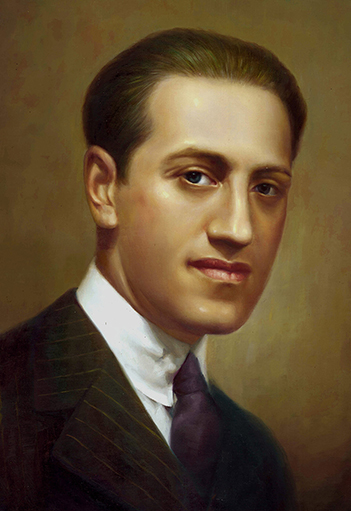 George Gershwin is way up there on my mental list of favorite American composers. From Rhapsody in Blue to the many wonderful songs ("Summertime," "Someone to Watch over Me," "Embraceable You," and "I Got Rhythm," just to name a very small portion of the man's output), his music bridges the gap between the Broadway stage and the classical concert hall.
Gershwin was the son of poor Russian emigrants who arrived in the U.S. a few years before he was born in 1898. At age twelve, he began to play the piano, and by age fifteen, had dropped out of school to hold down a job as a song-plugger in Tin Pan Alley. It was here that he became well-known among singers and other song-writers. His first song ("Swanee") was published less than two years later, and singer Al Jolson's recording of the song in 1920 received great acclaim.
With his brother Ira, George wrote many successful songs and musical comedies throughout his life. The now-famous songwriter sought out well-known composers for instruction in harmony and composition, and took sporadic lessons with musicians such as Rubin Goldmark and Henry Cowell. Besides the well-known Rhapsody in Blue (1924) and opera, Porgy and Bess (1935), Gershwin's classical works include a piano concerto (1925), a set of variations for piano and orchestra based on his song, "I Got Rhythm" (1934) and Cuban Overture (1932), along with several other pieces.

Anna Harwell Celenza has a perfectly lovely book featuring the story of how the composer came to write his first major classical orchestral composition: Gershwin's Rhapsody in Blue. In it she mentions some of the influences on Gershwin's compositions, including ragtime and Klezmer. The book includes a CD of the piece, as well, as played by the composer himself on a piano roll.
I have two favorites of Gershwin's that are among his lesser known classical pieces: Lullaby for Strings, and Prelude No. 2 from a set of three Preludes for Piano (1926). There is a YouTube video of a string quartet playing the Lullaby in its entirety here. The video quality isn't great, but the audio quality is pretty good, and the quartet is decent, even if they play the piece too fast for my taste (faster than I played it back in my wedding gig-playing days, anyway). Here it is (in Amazon exerpt form) at the "right" speed, which makes it just, well, dreamy:
Recording by Vesko Eschkenazy "and friends" on the CD, The Fascinating George Gershwin.
And my other favorite, another somnolent selection--the second of three Preludes for Piano:
as played by the equally delightful Michael Tilson Thomas (one of my heroes) on the CD, Classic Gershwin.
Pleasant dreams!
Subscribe to:
Posts (Atom)